Pages

Showing posts with label lizard. Show all posts

Thursday, December 27, 2012

Monitors

Family Varanidae


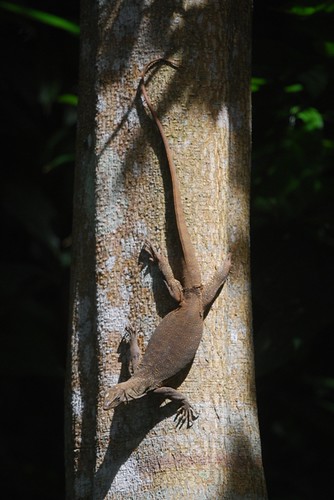
The Water Monitor (Varanus salvator) is one of the most familiar reptiles in Singapore. It is commonly found near rivers, mangroves and reservoirs. It can grow to 2 m long and is sometimes mistaken by visitors to Sungei Buloh as crocodiles. It is distinguished from the Clouded Monitor (Varanus nebulosus) by the position of the nostrils being near the tip of the snout, whereas the nostrils of the Clouded Monitor are midway between the snout and the eyes. It also lacks the yellow spots on the body of the Clouded Monitor. Habitat-wise, the Clouded Monitor prefers forests, whereas the Water Monitor prefers waterbodies. There is a third species of monitor in Singapore, the Dumeril's Monitor (Varanus dumerili), which is recently rediscovered in the Nee Soon Swamp Forest.

Clouded Monitor


©Tan GC. Hindhede Nature Park ©Tan KH


Sunning itself on Pulau Ubin ©Tan KH


Foraging at Central Catchment ©Tan KH

Water Monitor


Eating frog at Bt Panjang ©Eddy Lee


Arboreal wrestling at Pasir Ris Park ©Tan KH


Eating African Walking Catfish at Botanic Gardens ©Tan KH


Eating fish at Sungei Buloh ©Tan KH


Eating vinegar crab at Pasir Ris Park ©Tan KH


Eating turtle at Lower Peirce ©Tan KH


Eating Banded Bullfrog at Punggol Waterway ©Tan KH


Mating at Serangoon Reservoir ©Tan KH

Reference

http://www.reptile-database.org/db-info/taxa.html#Sau

Skinks

Family Scincidae1


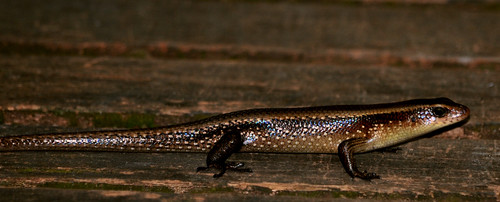
There are 8 species of skinks in Singapore. They can be separated into three main groups: tree skinks (3), mangrove skink (1), swamp skink (1) and ground skinks (3).

  1. Brown Tree Skink (Dasia grisea)
  2. Olive Tree Skink (Dasia olivacea)
  3. Striped Tree Skink (Lipinia vittigera)
  4. Mangrove Skink (Emoia atrocostata)
  5. Common Sun Skink (Eutropis multifasciata)
  6. Striped Sun Skink (Eutropis rugifera)
  7. Garden Supple Skink (Lygosoma bowringii)
  8. Singapore Swamp Skink (Tytthoscincus temasekensis)2


Common Sun Skink (Eutropis multifasciata) is the most common skink in Singapore. It can be found in gardens and parks, as well as forests. It is also called the Many-lined Sun Skink.


Telok Blangah ©Tan KH. Lower Peirce ©Melvin Dionio

Olive Tree Skink (Dasia olivacea) is uncommon and has greenish underparts.


Malaysia ©Tan KH

Bowring's or Garden Supple Skink (Lygosoma bowringii) is common and has short limbs.


Dead specimen at Punggol Waterway Park ©Tan KH

Reference


  1. http://www.reptile-database.org/db-info/taxa.html#Sau
  2. https://lkcnhm.nus.edu.sg/app/uploads/2017/04/65rbz574-584.pdf

Geckos

Family Gekkonidae1


Geckos are well known for their ability to hang upside down on ceilings. The "House Lizards" that one typically encounters at home are really geckos. There are 20 species that can be found in Singapore. At least 4 of them can be found in houses. The rest are forest geckos.

  1. Fox-faced Gecko (Aeluroscalabotes felinus)
  2. Peninsular Rock Gecko (Cnemaspis peninsularis)
  3. Frilly Gecko (Cosymbotes craspedotus)
  4. Flat-tailed Gecko (Cosymbotes platyurus)
  5. Peter's Bent-toed Gecko (Cyrtodactylus consobrinus)
  6. Singapore Bent-toed Gecko (Cyrtodactylus majulah)
  7. Marbled Bent-toed Gecko (Cyrtodactylus quadrivirgatus)
  8. Peninsular Bent-toed Gecko (Cyrtodactylus semenanjungensis)
  9. Four-clawed Gecko (Gehyra mutilata)
  10. Tokay Gecko (Gekko gecko)
  11. Spotted House Gecko (Gekko monarchus)
  12. Large Forest Gecko (Gekko smithii)
  13. Brooke's House Gecko (Hemidactylus brookii)
  14. Common House Gecko (Hemidactylus frenatus)
  15. Indo-Pacific Gecko (Hemidactylus garnotii)
  16. Dwarf Gecko (Hemiphyllodactylus typus)
  17. Mourning Gecko (Lepidodactylus lugubris)
  18. Brown's Flap-legged Gecko (Luperosaurus browni)
  19. Horsfield's Flying Gecko (Ptychozoon horsfieldii)
  20. Kuhl's Flying Gecko (Ptychozoon kuhli)


Sometimes foreign geckos followed shipments into Singapore. Here are two that might have done so.


Botanic Gardens ©Tan KH. Mandai Orchid Garden ©Lau SY.

Used to be grouped with Kendall's Rock Gecko, the Peninsular Rock Gecko (Cnemaspis peninsularis) is now treated as a separate species2.


Malaysia ©Tan KH

The Flat-tailed Gecko (Cosymbotes platyurus) is another urban gecko. It can be told apart by the flat edges of the tail.


Pasir Ris Park. Circuit Road ©Lau SY

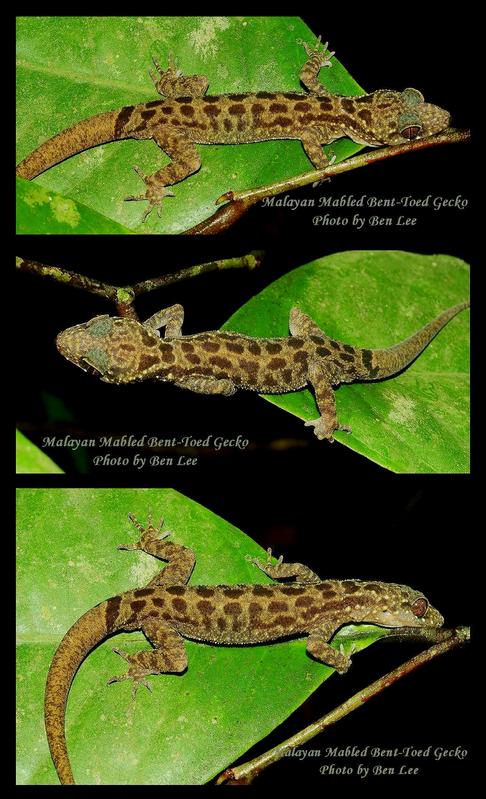
The Singapore Bent-toed Gecko (Cyrtodactylus majulah) has previously been mistaken as Marbled Bent-toed Gecko (Cyrtodactylus quadrivirgatus)3. It has black spots on its back. In some, the black spots merged to form alternative black and pale bands on the back.


Central Catchment ©Ben Lee

The Four-clawed Gecko (Gehyra mutilata) is another urban gecko. It does not have the spiny tail of the above species and only four of the five toes on each hind foot have claws.


Sungei Buloh ©Tan KH

The Tokay Gecko (Gekko gecko) is a large gecko with orange spots on its blue body.


Singapore Zoo ©Tan KH

The Spotted House Gecko (Gekko monarchus) has distinctive spot patterns on the back.


Hindhede ©Tan KH

The Large Forest Gecko (Gekko smithii) is a large gecko with green eyes.


Sabah, Malaysia ©Tan KH

The Common House Gecko (Hemidactylus frenatus) is also called the Spiny-tailed House Gecko. It can be told apart by the spiny edges of the tail.


Sungei Buloh. Kranji Resort ©Tan KH


Central Catchment ©Tan KH

The Dwarf Gecko (Hemiphyllodactylus typus) is one of the smallest geckos here.


Pulau Ubin ©Ben Lee

The Mourning Gecko (Lepidodactylus lugubris) has a very distinctive upperparts pattern.


Woodlands ©Tan KH

References

  1. http://www.reptile-database.org/db-info/taxa.html#Sau
  2. Systematics and natural history of Southeast Asian Rock Geckos (genus Cnemaspis Strauch, 1887) with descriptions of eight new species from Malaysia, Thailand, and Indonesia
  3. Marbled bent-toed gecko at Upper Seletar

Agamids

Family Agamidae


The Earless Agamid (Aphaniotis fusca) is not common in Singapore, being found only in forests. It is mostly brown with no obvious external ear, hence the name.


Malaysia ©Tan KH

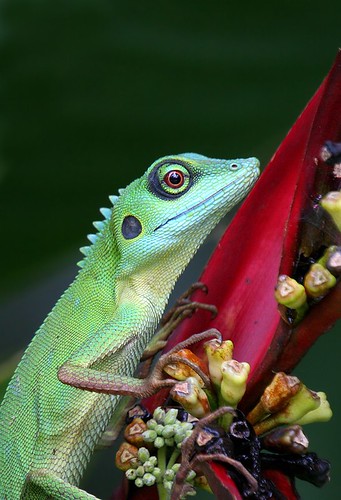
The Green Crested Lizard (Bronchocela cristatella) used to be a common lizard in Singapore. However, since the introduction of the alien Changeable Lizard, this species has been pushed into more wooded areas. It looks similar to the Changeable Lizard but is bright green in colour.
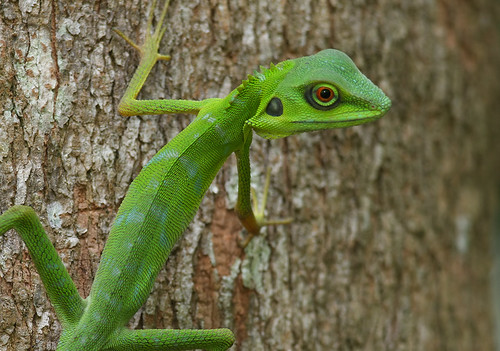

Bt Batok Nature Park ©Eddy Lee


Lower Peirce (left). Kranji Marsh (right) ©Tan KH


Sungei Buloh ©Tan KH

The Changeable Lizard (Calotes versicolor) is the most common lizard one would encounter in parks and gardens. It is however not native. It has taken over the niche of the native Green Crested Lizard, forcing the latter into more wooded areas. They are greenish to brownish, but the head and upper body of the males would turn orange and the throat black during the breeding season.


Botanic Gardens ©Lau SY


Admiralty Park. Lorong Halus ©Tan KH

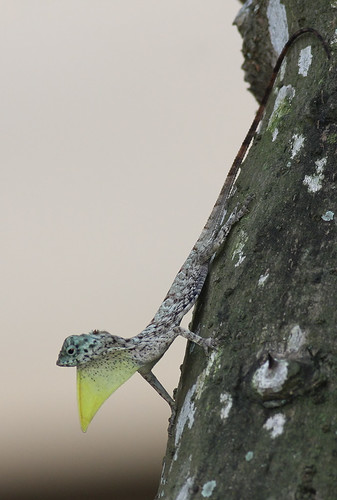
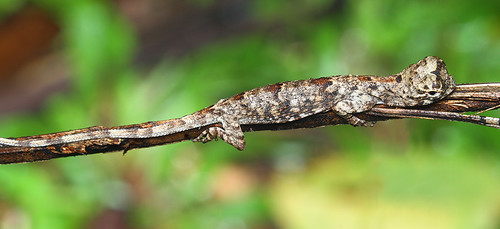
Flying Lizards are more correctly known as Gliding Lizards because they do not really fly but they glide. They do so by opening the flaps of skin between the legs and jumping off a high vantage point. They also have a flap of throat skin, which is used for communication and courtship. There are 3 confirmed species in Singapore.

The Black-bearded Flying Lizard (Draco melanopogon) is greenish in colour and has a black throat skin.


©Tan GC. Lower Peirce ©Lau SY


Lower Peirce ©Danny Lau

The Five-banded Flying Lizard (Draco quinquefasciatus) has five bands across the body.


Lower Peirce ©David Tan

The Common Flying Lizard (Draco sumatranus) has a yellow throat skin and a few rufous patterns on the back. It is also know as the Sumatran Gliding Lizard. It used to be called Draco volans.


Displaying. NTU ©Eddy Lee


Botanic Gardens. Pasir Ris Park ©Tan KH

References

http://www.reptile-database.org/db-info/taxa.html#Sau